Gooseneck Pin Box Comparison
The short answer: Six brands now build a pin box that turns your fifth wheel into a gooseneck. Here's how they actually differ — and how to find the bolt pattern you need first.
In This Guide
Six Brands, One Idea
A gooseneck pin box swaps out the pin box on the nose of your fifth wheel and replaces it with a gooseneck coupler. The trailer then rides on a 2-5/16" ball in your truck bed instead of a fifth wheel hitch. Pull the ball and the bed is completely clear.
For years the main names here were Reese, Gen-Y and Shocker. CURT, MORryde and B&W have joined more recently, so now there are six: Reese, CURT, Gen-Y, MORryde, B&W and Shocker.
One thing to get straight before the specs. This is a trailer-side conversion — you're modifying your RV, not your truck. It is not a single-point fifth wheel hitch (that's a truck-side head like the PullRite 3900 that sits on the ball and grabs your stock kingpin). People use the terms interchangeably online. They're different products with different trade-offs.
Before Any Of This: Find Your Bolt Pattern
This decides more than the brand does
Here's what trips people up. A gooseneck pin box is chosen by your trailer, not your truck. No brand fits everything, and every brand sells the same product in several versions. Get either of these two things wrong and you've bought the wrong $1,500 part.
1. Your pin box's bolt pattern
There's a sticker or plate on your existing pin box with the manufacturer and model number. That's the fastest answer. The common ones are Lippert 1621, 1621HD, 1116, 1716, 0719, Rhino and Turning Point, plus the Fabex PB 600 series.
Measuring instead? 2" between holes vertically means a 1621 or a Rhino; 2-1/2" means a 1116 or a 1716. A measurement alone only narrows it to "one of those two" — confirm with the label, or give the trailer maker your serial number.
2. Your pin weight or GVWR
Every spring-based pin box is sprung for a weight band. Too stiff for your trailer and it rides badly; too soft and it's not rated for the load. Buying the biggest number is not the safe choice — it's a worse ride.
MORryde and Gen-Y band by trailer GVWR. CURT and B&W band by pin weight. Pin weight is typically 15–25% of loaded trailer weight, but weighing it is better than estimating.
The Specs, Side By Side
Manufacturer-published numbers only
No one has crash-tested these against each other, and we're not going to pretend otherwise — there's no "best riding" column below because nobody can honestly fill it in. What you can compare is how each brand absorbs shock, what it's rated for, what fits your trailer, and what it costs to keep running.
| Brand | How it absorbs shock | Tunable? | Upkeep | Capacity | Pin weight | Bolt patterns |
|---|---|---|---|---|---|---|
| Reese Goose Box | Air bag + dual shocks + rubber springs | Yes — air pressure | Check air pressure; grease coupler and pivot before each use | 20,000 / 22,500 lb (20,000 on Rhino) | 4,000 lb (per Reese manual) | Lippert 1621, 1716, 0719, Rhino; Fabex PB 600 |
| CURT Helux | Automotive-grade coil spring + shock | No — pick the spring rate at purchase | None published | 20,000 lb (whole line) | 2,350 / 2,700 / 3,200 / 3,900 / 4,300 / 5,000 lb | Lippert Rhino Box pattern |
| Gen-Y Executive Torsion-Flex | Rubber torsion (Torsion-Flex) | No — pick the GVWR tier at purchase | None published; ~1,000 mi break-in | Up to 30,000 lb (two GVWR tiers) | 4,500 or 6,500 lb by tier | LCI Rhino, Lippert 1621/1621HD, 1116/1716 (shims), LCI Turning Point |
| MORryde GooseTech | Rubber shear spring | No — pick the GVWR band at purchase | None — no greasing, no adjustments | 24,000 lb (Rhino, 1621SHD) · 19,000 lb (1116) · 18,000 lb (1716) | Sized by trailer GVWR band, not a pin number | Lippert 1116, 1621/1621SHD, 1716, Rhino |
| B&W 5th Wheel to Gooseneck | SumoSpring, dual-axis cushioning | No — pick the pin weight at purchase | No airbags or break-in; grease joints every 2,500 mi | 25,000 lb (whole line) | 3,250 or 4,500 lb | Lippert 1621/1621HD; Rhino version; 1116/1716 with shim kit |
| Shocker Quick Air | Air spring in the coupler stem (Quick Air kit); non-air stems too | Yes (air kit) — start ~15 psi, tune in 5 psi steps | Air pressure; no pin box bolts included | 24,000 lb (as a complete kit) | 6,000 lb | Lippert 1621/0719/Rhino · 1716/1116/0115 + FabEx · Turning Point |
Specs as published by each manufacturer, checked September 2026. Ratings and fitment change — verify against the current instruction sheet before you order.
Brand By Brand
What's actually different about each one

Reese Goose Box
One of two air-ride options here (Shocker's Quick Air is the other), so you can tune the ride to your actual loaded weight. Gen 3 (94920) supersedes the older 94716/94720.

CURT Helux
Capacity is identical across the line — the only thing the part number changes is the spring rate. CURT claims up to 30% less force into the RV frame and body than an unnamed competitor. Built to order.
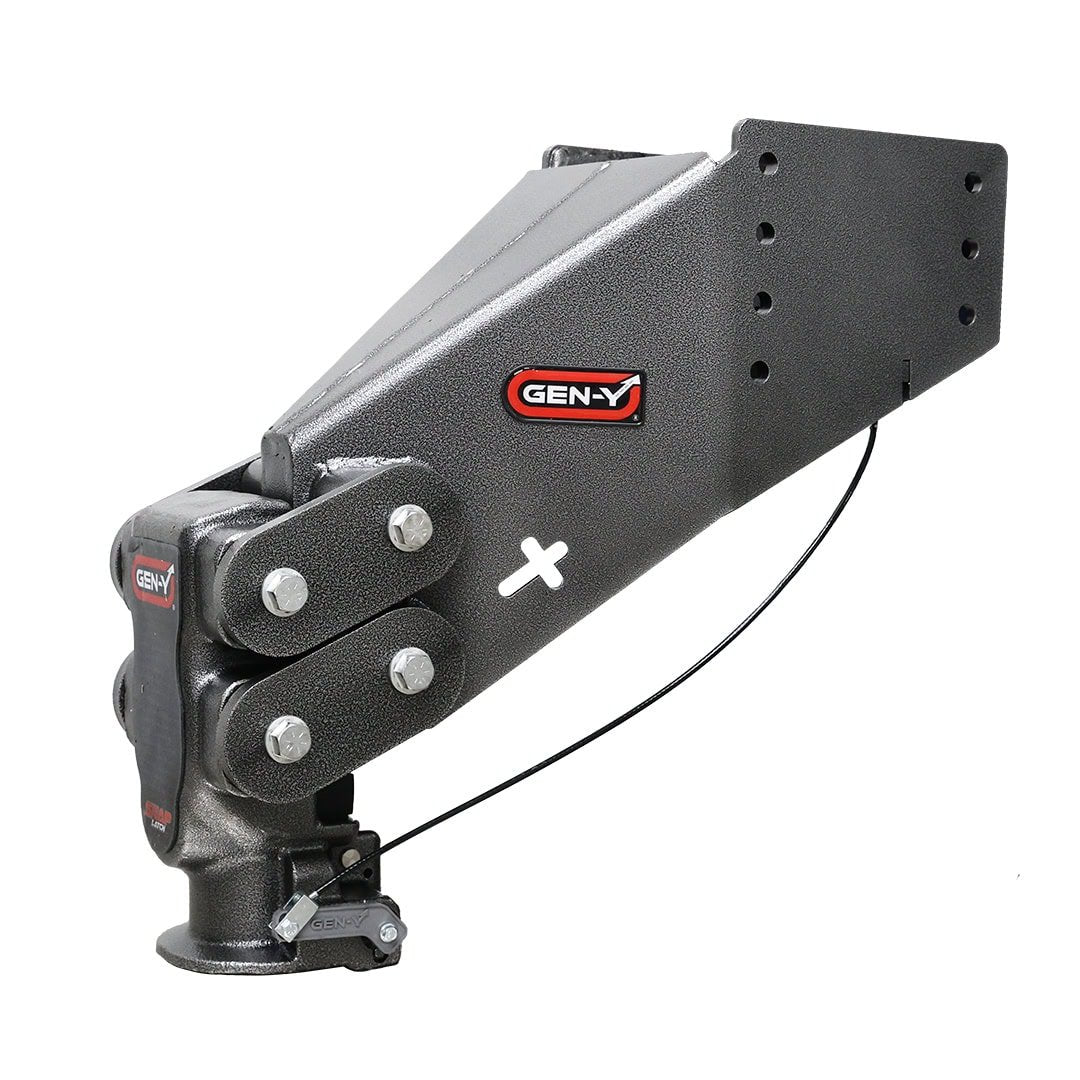
Gen-Y Executive Torsion-Flex
The only one here rated to 30,000 lb, and the highest pin weight here (6,500 lb on the upper tier). Current versions use Gen-Y's self-latching SnapLatch coupler. Gen-Y says customers report up to 90% smoother towing.
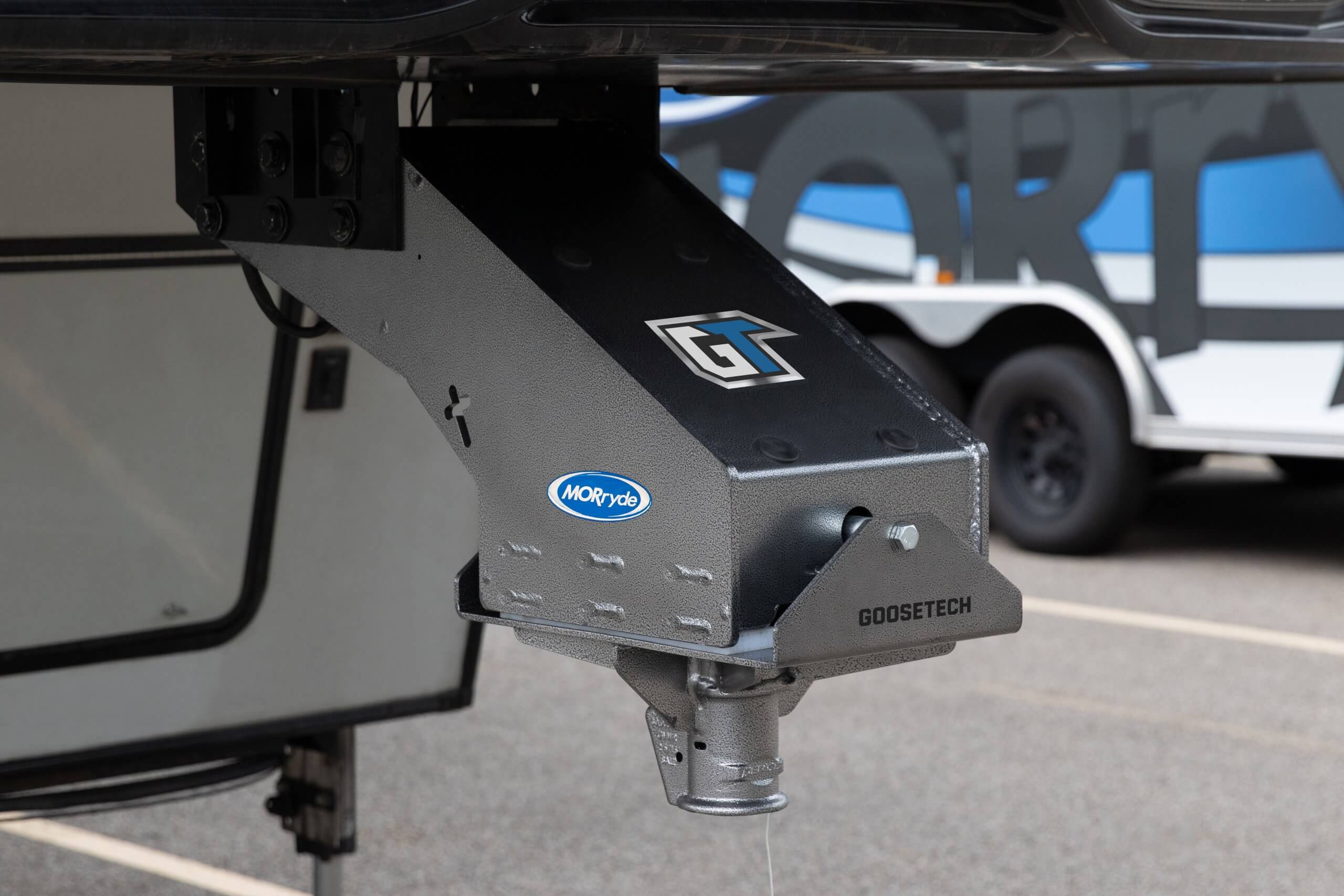
MORryde GooseTech
3" of fore/aft travel — the direction chucking happens. Auto-latching coupler with remote release. Chains sold separately (MORryde kit RGN77-001).
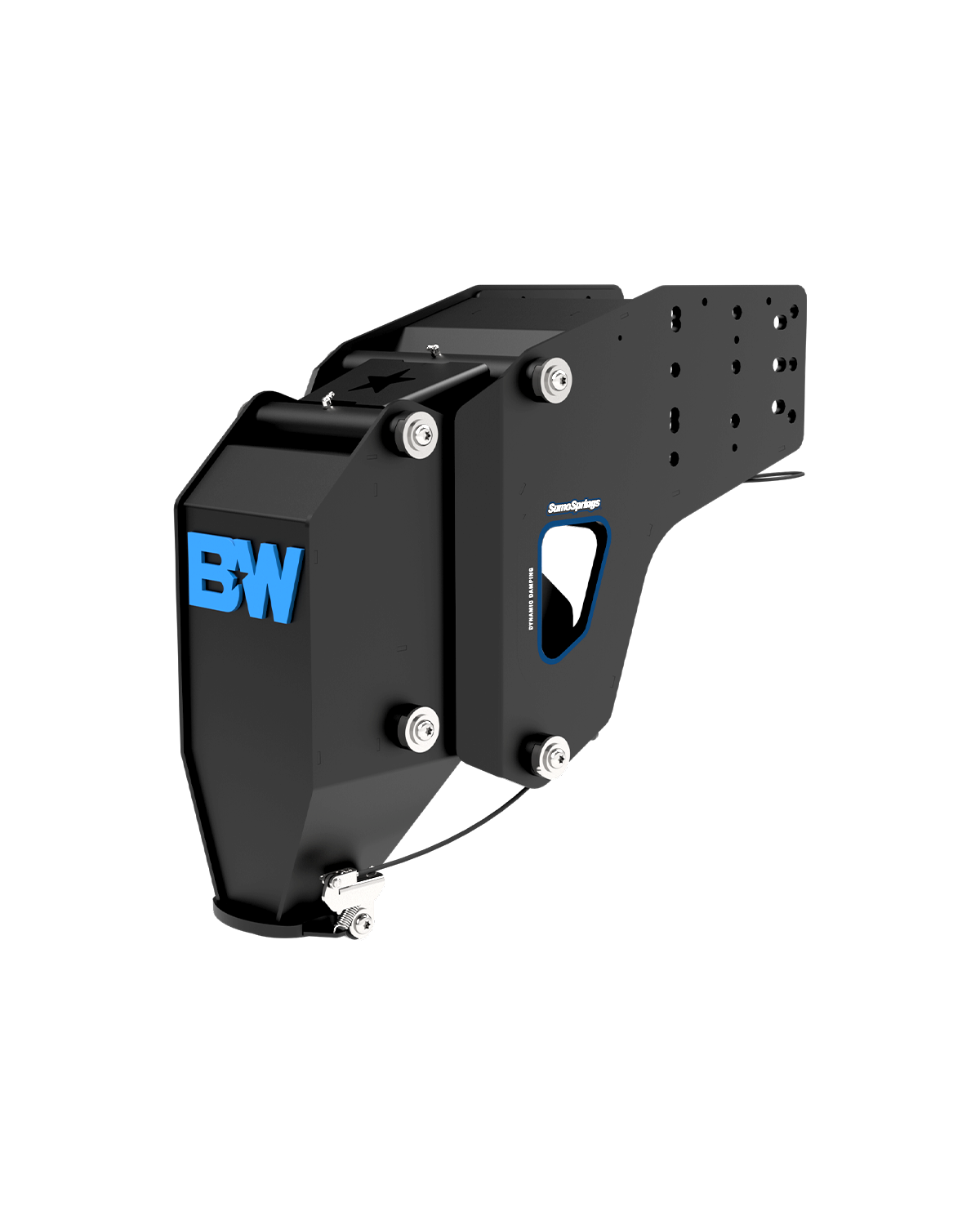
B&W 5th Wheel to Gooseneck
Newest entry in the category; B&W markets it as damping both vertical and horizontal movement. B&W states use should not void your trailer frame warranty — worth checking against your own trailer maker's wording. Two 42" chains included; Ram HD with the prep package needs the longer chain kit.
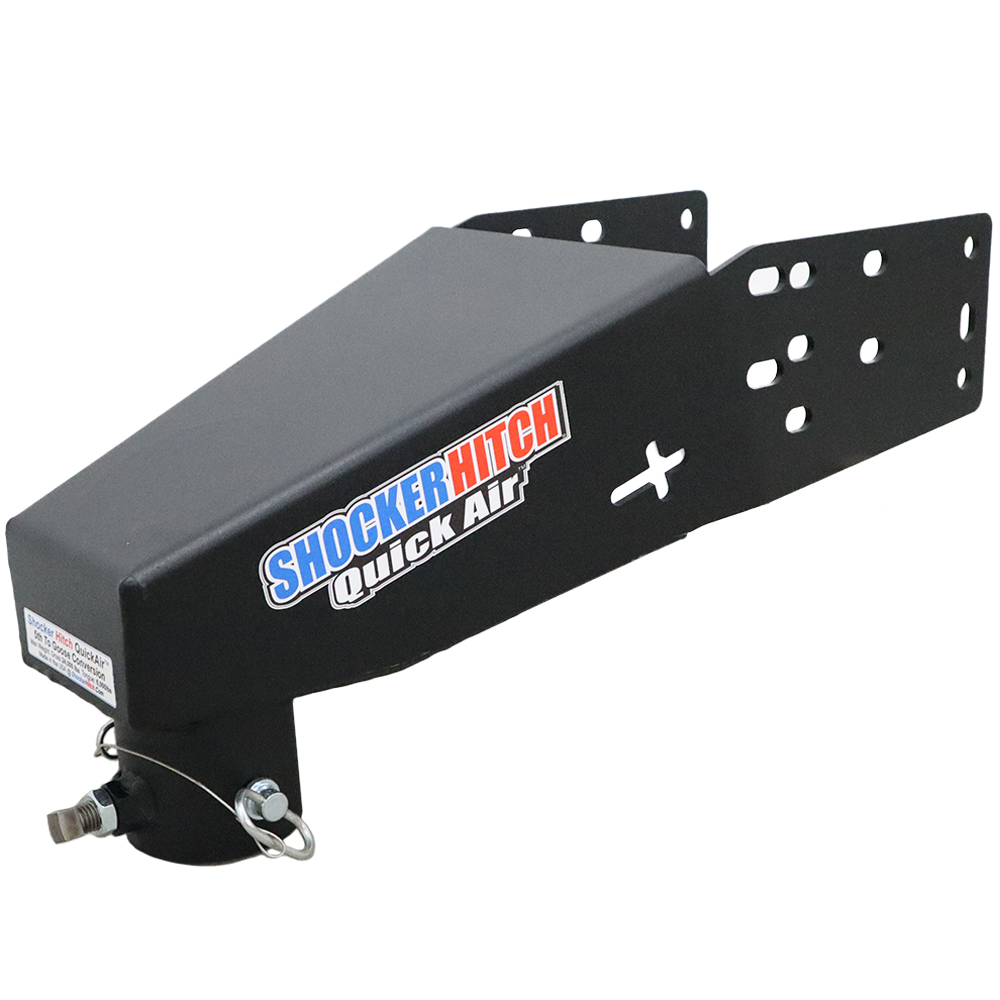
Shocker Quick Air
The structural odd one out. The pin box is a plain steel shell (~$600–$650) with a 4" socket; the coupler goes in on a separate stem. The Quick Air stem carries the air spring (kit ~$1,800–$2,100); a non-air stem with a Shift Lock or Demco coupler makes a ~$720–$1,000 kit. It all stays on the trailer and fits a standard 2-5/16" ball. Compare kit prices, not shell to pin box.
Air Or Spring?
The one real design split in this category
Every brand here sells a cushioned version (Shocker and Gen-Y also sell unsprung ones). They just do it two different ways, and the difference shows up in what you have to do afterwards rather than in a spec sheet number.
Air (Reese Goose Box, Shocker)
- • Air pressure sets the spring rate, so you can tune it to how the trailer is actually loaded
- • One model covers a wider weight range — less pressure to get the purchase exactly right
- • Air pressure is something you check, and the bag is a wear item
- • Reese fills through a manifold with an auto relief valve; Shocker starts around 15 psi and is tuned in 5 psi steps by test drive
Spring (CURT, Gen-Y, MORryde, B&W)
- • Fixed rate — nothing to inflate or adjust after install (routine greasing still applies; B&W lists grease points every 2,500 miles)
- • No bag to fail and no air pressure to check before a trip
- • You commit to the spring rate at purchase — which is why each brand sells 4–15 versions
- • Coil (CURT), rubber torsion (Gen-Y), rubber shear (MORryde), SumoSpring (B&W)
The Shocker asterisk
Shocker is built differently: the pin box itself is a plain steel shell with a 4" socket, and the coupler goes in on a separate stem. With a non-air stem (Shift Lock or Demco coupler) the complete kit is about $720–$1,000; with the Quick Air stem, which has the air spring built in, it's about $1,800–$2,100. The shell alone is about $600–$650 and does nothing without a stem. Either way it all stays on the trailer and couples to a standard 2-5/16" ball. Compare complete kit prices, not the bare shell against another brand's pin box.
What Else You'll Need
The pin box is not the whole bill
A gooseneck hitch
You need a ball in the bed. If your truck has the factory puck system, a puck-mount gooseneck ball drops in. Otherwise it's an under-bed hitch like a B&W Turnoverball or CURT Double Lock.
Safety chains
Required for gooseneck towing. B&W includes two 42" chains; MORryde and Shocker sell them separately. Ram HD trucks with the prep package need B&W's longer 51-1/2" kit.
An offset ball, on a short bed
Moves the pivot rearward for cab clearance. Match your hitch brand — B&W ball for a B&W hitch, CURT for CURT. Offset balls work with a pin box only, never with a single-point hitch.
A couple of brand-specific ones: Lippert 1116 and 1716 pin boxes need shim plates on both the B&W and the Gen-Y. Shocker's kit doesn't include pin box bolts — you reuse the existing ones.
Still Deciding?
If you haven't settled the bigger question yet — whether to convert the trailer at all instead of buying a fifth wheel hitch — start with Gooseneck Pin Box vs Fifth Wheel Hitch. It lays out both sides without pushing you either way.
Related reading: Pin Box Upgrades Explained covers the cushioned and rotational pin boxes that keep your kingpin. Gooseneck vs Fifth Wheel explains the two connection types. Short bed? Read Short Bed Towing before you order an offset ball.
Related Guides
Convert the trailer to gooseneck, or buy a fifth wheel hitch? Bed space, real total cost, resale, short beds and warranty — laid out both ways.
Read guide →Aftermarket pin boxes — what they do, when you need one, and which ones are worth it.
Read guide →The difference between gooseneck and fifth wheel connections — pros, cons, and when to use each.
Read guide →